The Demo Illusion
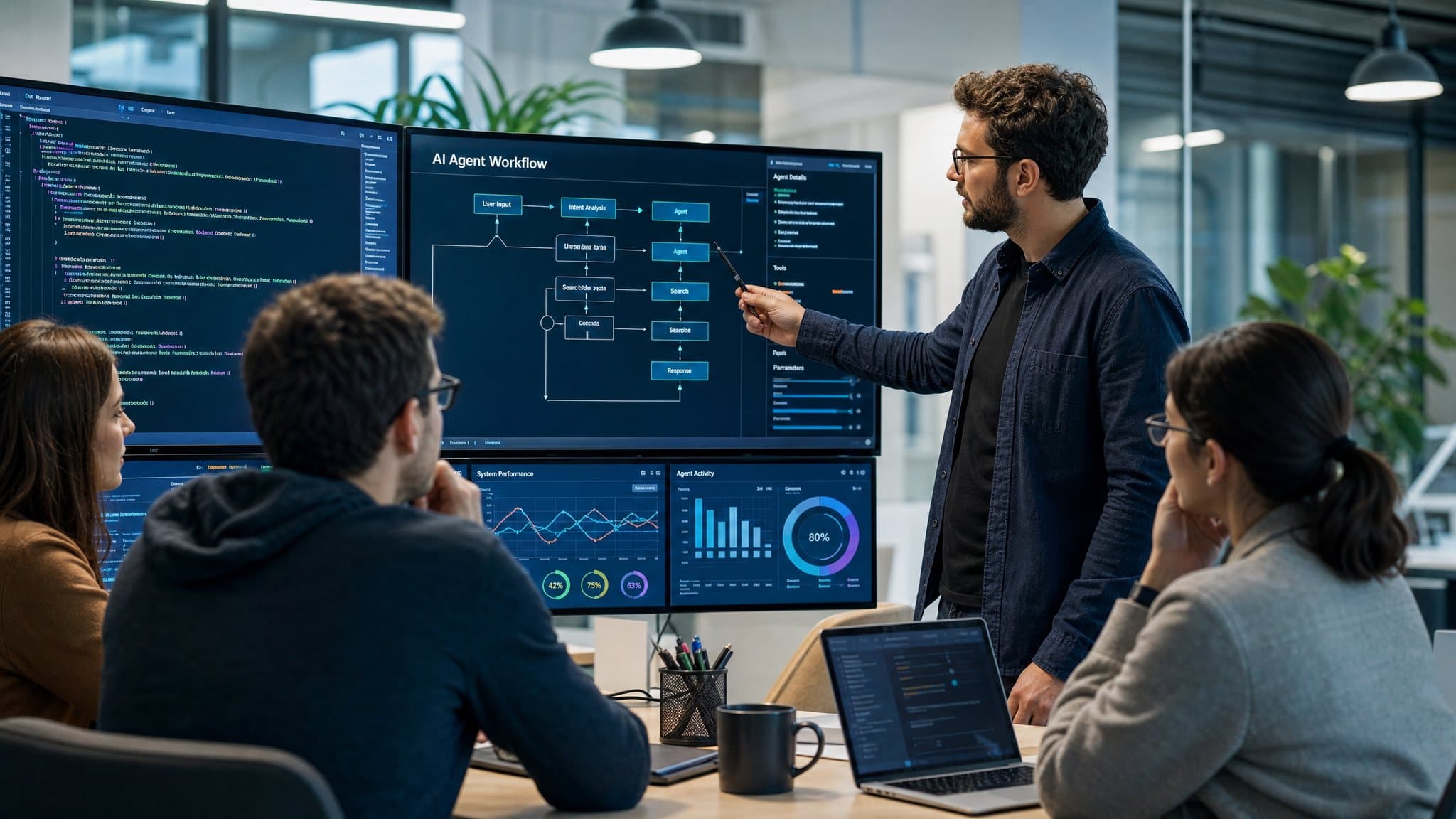
We have all seen the impressive demonstrations. An AI agent seamlessly navigates a complex workflow, books a flight, writes a comprehensive report, and sends an email—all from a single prompt. These demonstrations are captivating, but they often create a dangerous illusion for business leaders. The gap between a controlled proof-of-concept and a production-ready AI agent is massive, and underestimating this gap is the primary reason enterprise AI initiatives fail.
When building a prototype, developers control the environment. The inputs are predictable, the APIs are stable, and the edge cases are conveniently ignored. However, when you deploy an AI agent into a live business environment, it encounters the messy reality of unstructured data, rate limits, unexpected user behavior, and system latency. A prototype that works perfectly 90% of the time in a demo will fail catastrophically when exposed to real-world complexity.
The True Cost of Reliability
Moving an AI agent from a prototype to production requires a fundamental shift in engineering mindset. You are no longer just writing prompts; you are building resilient, fault-tolerant systems. This transition introduces significant hidden costs that most organizations fail to anticipate.
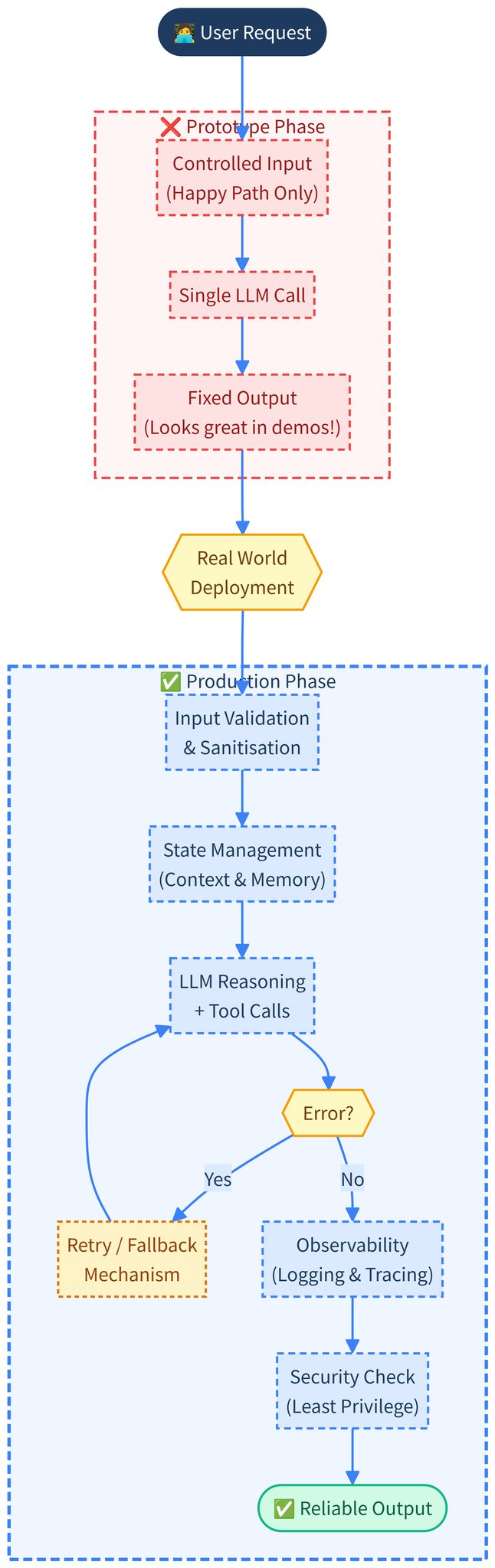
First, there is the challenge of state management. A production agent must maintain context across long-running interactions, handle interruptions gracefully, and recover from failures without losing progress. Second, there is the issue of observability. When an agent makes a mistake, you need comprehensive logging and tracing to understand exactly why it made that decision. Without robust observability, debugging an autonomous system becomes an impossible task. Finally, there is the critical requirement of security and access control. An agent that can execute actions on behalf of a user must be strictly constrained by the principle of least privilege, ensuring it cannot accidentally delete a database or expose sensitive information.
The Infonex Approach to Production Agents
At Infonex, we approach AI agent development with the same rigor we apply to traditional enterprise software. We do not just build impressive demos; we build systems designed to operate reliably at scale.
Our methodology begins with spec-driven development. Before writing a single line of code or crafting a prompt, we define the exact boundaries of the agent's capabilities. We establish clear success criteria, identify potential failure modes, and design fallback mechanisms. This structured approach ensures that the agent's behavior is predictable and aligned with business objectives.
Furthermore, we implement comprehensive testing frameworks specifically designed for autonomous systems. We do not rely on manual testing; we build automated evaluation pipelines that continuously test the agent against a vast array of edge cases and adversarial inputs. This rigorous testing process is the only way to guarantee that an agent will perform reliably when deployed to production.
The Takeaway
Deploying AI agents in a production environment is not a prompting exercise; it is a complex software engineering challenge. Organizations that treat AI agents as simple integrations will inevitably struggle with reliability, security, and scalability issues.
To succeed with AI agents, you must prioritize robust architecture, comprehensive observability, and rigorous testing. By partnering with an experienced team that understands the realities of production AI, you can bridge the gap between impressive prototypes and reliable, value-driving systems.
Ready to move your AI initiatives beyond the prototype phase? Talk to us about how Infonex can help you build and deploy production-ready AI agents.